Friday, 21 December 2012

Evaluation

Sense of Place Evaluation


Our initial idea for this project was to convey a busy area by setting up a static camera in a crowded location and creating a time lapse of the events that unfold in front of the viewfinder. We later decided to altercate this idea however, as we felt that the film would have been too dull due to the lack of camera movement. As such we decided to portray a busy area by placing a character in shot, filming cutaways to annoying sounds and by using rhythmic editing to build a crescendo of noise until the character is forced to block out his surroundings. After a tutorial we were dissuaded to use our first idea of forcing the character back into reality after shutting it out as it was too clichéd. This lead to us arriving at our final idea: we determined to concentrate on the conflict between an internal peaceful space and a busy exterior space. We then began to search for sources of inspiration by searching the internet for images and ideas we both liked. We found a video on youtube called 'Amazing time lapse video' (see bottom of post for video) that inspired us to create our own time lapse as we felt the super fast images would emulate a hectic space. We also found inspiration in the sound effect created by a loop pedal, a good example of this being an Ed Sheeran song named 'you need me, I don't need you' (see bottom of post for video). We both liked the way the effect pedal builds up layers of sound by repeating them over and over in the same pattern, this is an effect we attempted to emulate in our video as the character's surroundings build up to an intolerable level of noise.

One of the most effective aspects of our video in my opinion is our implementation of rhythmic editing. Initially we only used this technique during the build up to the crescendo however, after showing our film to the class, the overwhelming suggestion was to continue the rhythmic editing patten throughout the whole video. We therefore returned to the editing room and altered the film's structure; we introduced the rhythm earlier and continued it throughout the entire film (we had previously not included it in the section that portrays the character's internal space). I feel that this alteration to the film's structure has improved it greatly as a production by creating continuity; before the change the video it felt slightly disjointed which detracted from the ideas integrity. We also decided to introduce the 'calming section' before the crescendo as well as after due to feedback from the viewing in order to emphasise the conflict between the two spaces from the very beginning. Through the earlier introduction of this scene we also established our films main motifs at a prior stage, giving them a much stronger impact. We used the fish tank as a metaphor for entrapment as our character is ensnared by reality whilst he fights to block it out. Our intention behind the record player was to foreshadow the looping rhythm that runs throughout the video and to suggest that the character is himself stuck in a exasperating loop. Finally, we introduced the fire place motif to act as a visual representation of the 'quiet place' that our character is attempting to enter. I feel that all of these motifs work fairly successfully due to the connotations and semiotics they bear; without them our film would be far more literal and the viewer would not be able to formulate their own reading.

I feel that another successful aspect of our video lies in our framing and composition, one of my favourites being the opening shot of the record player at the start of the film. In order to create this shot I had to return home by train as this was the only way we could access a record player. I then waited until dark, closed the curtains and eradicated any source of light in the room so that it was pitch black. I then positioned a desk lamp behind the record player facing towards the camera so that the glare from the bright light would black out the background. I also used a tripod in order to ensure the camera was completely still as any wobble would ruin the framing. I feel by taking the time to set up the light and the room, the shot feels fairly professional and looks as though it could have been filmed in a studio. The only problem we encountered when editing this shot was that the background was just visible which pulled the focal point away from the record player slightly. In order to rectify this small problem we created a matte effect (specifically mask shape) on final cut pro and arranged it so that the backdrop was completely black and all focus was on the player. We also implemented the mask shape effect on the shot where out actor is sitting on a bench outside the train station. We used this effect to fade the background out and dissolve in a time lapse of the busy station exterior whilst keeping the character's head in the composition. We found this effect slightly more difficult as it required for us to create two layers; one for the original shot and one for the background and for us to overlap the two shots. We then created a dissolve and a shape mask and placed them on the first shot of our actor on the bench. However due to the intricacy of this editing technique our first attempt looked to sharp and jarring, a problem we solved by using a mask feather to soften the edges of the image mask. These effects were far in advance of anything either of us had previously attempted and as such provided us with a new set of skills to work with for future projects.

This project also provided me with an entirely new skill set with the programme sound track pro (of which I had previously never used). A lot of the sound effects we utilised in our video required some alteration in order to match the footage. For example the sound effect we recorded for the fingers tapping initially sounded tiny and unnatural, in order to get around this problem we used the channel EQ effect to lower the sound's base and also to reduce the audio file's treble. This gave the sound more depth and as such ensured that it fitted with the video much more succinctly. We also used the channel EQ effect to create unnatural synth sounds to provide jarring dissonance between some shots and their audio in order to highlight the theme of conflict between reality and imagination. A good example of this being the deep base sound that underlays the crescendo. To create this effect we placed a surface mic on a rail in a stairwell at uni. We then banged the rail repeatedly and copied the sound onto a mac from the marantz. After obtaining the sound we completely removed the treble and dramatically lowered the base to create an uncomfortably low rumble that creates unease during the build up sequence. Another synth sound that we created, we used to match the stop sign motif. We moulded an unpleasant, electronic buzzing, tearing sound in order to highlight the idea that our character is being forced back into reality from the quiet space he created. To craft this sound we placed a surface mic on a granite surface and scraped glass bottles across it, the sound it picked up was incredibly piercing and unpleasant. We then lowered the sound's levels on soundtrack pro to make the sound bearable (it was too unpleasant to listen to in its original state) and implemented it every time the stop sign appeared. Having never used this programme before I am very pleased at how much my skills have advanced and I feel I am building a catalogue of sounds that could be useful in future projects.

The main problem that we faced with our sound was that we created the sound scape using headphones and did not think to play the project back using speakers. Because of this error the final project sounds far better on headphones than it does on a sound system; we noticed whilst presenting the film that some of the treble sounds are much too quiet and a couple of the film's base notes did not show up. This is an issue that we could easily of avoided, had we thought to play the audio on a range of different speaker systems whilst editing; then we could have adjusted the levels accordingly. Another issue that arose due to this error was that the sound effects we had panned from one headphone to the other did not work as well as we had hoped. At the climax of the film's crescendo we included two shots of a one way sign, one played forwards and one in reverse (the effect of which was to continue the motif of the 'loop'). To further emphasise these two shots we created a key frame at the start and the end of the image, then panned the sound from the left earphone to the right and back again. We both felt that this technique sounded effective when listening to the project on headphones. However when playing the audio on speakers the panning effect was drowned out by the other layers of audio that were playing at the same time. Whilst this is a small issue it is one that can easily be avoided on future projects playing the film on a range of speakers before presenting.

I feel the process of making this project went very smoothly; we scheduled two shoots and managed to obtain all of the footage we needed first time around. This is because we carefully storyboarded and shot-listed prior to filming so that we knew exactly what we were doing on our filming days, thus making the process flow smoothly. We did however have to go out multiple times to record sound as we either did not have enough or the audio we gathered did not sound right when placed on top of our footage. This niggle did slow down the editing process slightly and taught us to plan out what sounds to record before capturing to avoid having to waist time on multiple excursions to gather audio. Perhaps one of the biggest problems we faced however was in the editing process, neither of us had a hard drive to back up our work with and as such we regularly faced the issue of not being able to access the mac that we needed. We also lost our entire sound project at one stage and had to re-make it from scratch. This is an issue I will avoid in future as I now have a hard drive and as such can prevent this problem from reoccurring.

Throughout the video we cut away to close ups of annoying sounds and road signs. In order to highlight their significance and to provide a wider range of techniques and shot types we used a fish eye lens whilst capturing these close-ups. This lens distorts any horizontal lines and creates a concave image. I feel that this technique work most effectively on the stop sign shot as the concave lens brings forward the bold circular sign and pushes the background out of the centre of the composition. Our main intention behind this idea was to continue the fish tank motif in a more subtle manner, I think we were relatively successful in this aim.

I greatly enjoyed working with Luke and feel that we gelled well as a team. We both contributed a large creative input and our combined knowledge of camera techniques and editing patterns helped our video succeed in its aim of portraying a sense of space.

Inspirations:

Amazing time lapse video


SB.TV -Ed Sheeran- "You need me, I don't need you" - A64


Project Planning


Shot List


Before filming we decided to create a list of every composition and we needed for our experimental film. This was a way of ensuring that we would get all of the shots required and reduced the chance of having to waist time re-shooting.

Departure

Sheffield Train Station                                                                                                       Date: 27:11:2012

Shot number:
Shot description:
1
wide shot of actor on Bench
2
close up of actor on Bench
3
time lapse of station
4
over the shoulder of actor+ sky
5
over the shoulder of actor+ station timetable
6
time lapse of clouds
7
extreme close up of actor's eye
8
Shot of vending machine
9
Close-up of fountain
10
Wide shot of fountain


Central Quay                                                                                                                    Date: 04:12:2012

Shot Number:
Shot Description
1
Close-up of coins in hand (fish-eye)
2
Close-up of coins landing (fish-eye
3
Close-up of fingers tapping
4
Stop sign (fish-eye)
5
Road sign (fish-eye)
6
Close-up of coin spinning (fish-eye)


Wheldrake                                                                                                                        Date: 09:12:2012

Shot Description
Shot number:

1
Wide shot of record player
2
Close up of record player
3
Birds eye view of record player
4
Close-up of fish tank
5
Wide shot of fire place
6
Mid shot of fire place
7
Close up of fire place
8
Zoom out of fire place

Project Planning

Storyboard


In order to create a coherent, flowing film we decided to story board our shots prior to filming, this ensured that we had a clear idea of the direction in which our film was going. 

first page of our storyboard:


Project Planning

                                          Mind Map of Potential Ideas


The first step we took in approaching this project was to brainstorm any ideas we had come up with individually and then pick out the ideas that worked the best. 


Wednesday, 12 December 2012

Experimental Film Research


“Empire”


Its 1964, Stanley Kubrik is releasing arguably one of the greatest films of all time 'Doctor Strangelove or: How I Learned to Stop Worrying and Love the Bomb', Dick Van Dyke is procuring infamy for his questionable cockney accent in 'Marry Poppins', Sergio Leone is cementing the ever growing popularity of the 'spaghetti western' with his hit 'a Fistful of Dollars' and Andy Warhol is confusing the public with 'Empire'; a film often referred to as being completely un-watchable.

'Empire' is an experimental film which consists purely of a single shot of the Empire State Building at night. Throughout the film's run time the camera never moves and there are no edits at all; an intriguing prospect, so why did Warhol's movie have audiences demanding there entrance fee back? Put simply the film is long, very long, so long that even the most dedicated Warhol fan would struggle to endure its eight hour and five minutes running time. Due to the oddity and length of the video 'Empire' has never been distributed on home video or DVD, in fact the movie can only be viewed in the Andy Warhol Museum and even then only a sixty minute extract is projected.

So what is the reason behind such an un-watchable experimental film? When asked, Warhol simply replied 'to see time go by'. I feel before we can begin to comprehend such an ambiguous explanation it is important to remember that Warhol was primarily a painter and to paraphrase Adrian Apro (a film historian), it's as if the abstraction of the world is spotlighted with one static skyscraper. After watching a twenty minute section of 'Empire' I began to find meaning in this statement. The film is so abstract, so minimalist that it becomes captivating, almost hypnotic. I felt that the film almost helps its viewers to appreciate the excitement and beauty that, when looked for can be found in the mundane and the every day. For example after ten minutes of blankly staring at the flickering image I found myself excited by a light turning on at the base of the tower, as it provided a change, a slight altercation to the unwavering formula. I was then left questioning how did I derive any form of enjoyment from such a dull scene? Lets see Micheal Bay inspire that kind of reaction from his viewers.

Warhol has completely subverted all expectations and preconceptions of conventional cinema and produced an abstract film that relies on the viewer to approach subjectively for them to obtain any kind of reward for their endurance. I feel that the film contains a deeper level of meaning than 'I'm watching Warhol stare out of a window'. The very unwatchability of 'Empire' is its ally, it forces the viewer to question their opinions of cinema and to consider that perhaps it is important not to let a film 'think for you'. That being said I would not want to sit through the whole eight hours and five minutes!


Sunday, 9 December 2012

Experimental Film Research


'the Perfect Wrestler'


After being set the task of creating an experimental film I decided it would be fruitful to research the style and its conventions as it is a genre that I have never come across before. After looking into this style of cinema I discovered that experimental films are characterised by a lack of any traditional linear narrative and that it is left for the viewer to deduce their own meaning from the film. This means that the director creates multiple readings via the implementation of signs and semiotics; one viewer may read the film in a completely different manor to another.

I then began to view experimental films using sites such as vimeo and youtube so that I could gain a clearer insight into the style of cinema. The first film I came across was a very low budget production named 'the Perfect Wrestler' by Cristian Britten & Steven Evans. This being my first experience of experimental film making I was initially left perplexed by the film's lack of structure. It was not until my second viewing that the shorts meaning became apparent; Britten & Evans have created a study into the limits that people are willing to go to in order to achieve 'perfection'.

The film begins by casting us into a bizarre orb of confusion. A Mexican wrestler lies asleep on the flaw, restless, twitching, his mask constricting his face, captured with a high angle medium close up and accompanied by a non diegetic voice over procuring 'The perfect Mexican wrestler, watch him dream'. The camera cuts away to an out of focus shot of the wrestler running, once again accompanied by a voice over 'the perfect wrestler is running, running perfectly'. As if this wasn't bizarre enough the video progresses to show the wrestler, waiting and starring 'perfectly' and to show him battling with the 'perfect wolfman' and the 'perfect squid man'.

What then is the meaning of this strange concoction of images? Why are we watching a man in spandex awkwardly running and posing heroically? It is not until the final shot of the short film that we can make any kind of sense of this visual rubix cube. We see the wrestler walking out out to sea, further and further until he is no longer visible, we then wait a few seconds and the narrator delivers the final lines of his spiel: 'the perfect wrestler is drowning, drowning perfectly'. It is now that we realise that the film is an allegory for the pursuit of success, and the crushing obsession perfection creates. The wrestler is a mere medium to portray this message, his profession requires him to be the best, he runs, walks and stares 'perfectly', he wrestles with monsters and wins yet still he turns restlessly in his sleep. Britten & Evans want to show that the wrestler will never be the best, and as such he is destroying himself by striving to achieve something unachievable. The monsters he wrestles with are his preconceived goals and as he drowns in his dreams he is lost in a vast sea that provides a fitting metaphor for failing to reach your aims.


Tuesday, 4 December 2012

Shake Me Down Music Video


Cage the Elephant: Shake Me Down


Waves crash, a man awakes, he steps into a bracingly cold morning and runs. His pale, aged face is distorted by the snow flecked air until he reaches a burrow and enters. His face relaxes, anguish is replaced by warm nostalgia; he has climbed into his childhood.

Shake me Down, a blisteringly poignant song by American rock band Cage the Elephant, vocalises a dying man's last moments. The song is accompanied by an incredibly powerful music video directed by Isaac Rentz that earned the band a nomination for best music video at the 2011 MTV video music awards. The video opens with an establishing landscape shot of waves crashing into rocks; a visual accompaniment of the line 'I have seen people walk into the sea', a metaphor for giving up and letting go. We then cut to an aged man waking up, perhaps suggesting that the previous shot was a memory or a dream, either way Rentz instantly familiarises his audience with the video's surrealist style. A series of uncomfortably tight, shaky close-up shots of the video's protagonist getting up and washing his face follows, this short sequence tells the viewer that something is not right as the unsteady camera mimics the man's frailty. We then see a succession of close ups of family photos mounted upon wooden walls suggesting that this frailty doesn't just derive from the man's age, but a loss of those close to him.

It is not long after this uncomfortable montage that the man begins jogging through streets ravaged by winter cold, he runs past snow covered grass, dead trees and stop signs, all of which act as a metaphor for death and thus foreshadow the film's touching ending. Our protagonist then reaches a small door in a leafy ditch and the video takes a surreal turn, he enters and discovers a burrow wrapped in sheets and pillows all of which give the location the feel of a child hood sofa fort. He crawls further into the bizarre fort until he is greeted by a room containing two children play fighting with swords, surrounded by toys. A sight that at this point leaves the viewer confused, what is this burrow? He continues to crawl through the burrow and comes across an American football which he picks up and embraces whilst the video cuts to grainy footage of a child playing catch with his father. It is at this point that the viewer realises what is going on, we are witnessing a dying man relive his childhood memories. A succession of painfully touching memories edited with quick jump cuts follows; he relives his marriage, interactions with his father, attention from his mother, these thoughts accumulate into an unsettling pool of nostalgia that nearly reduces the man to tears.

This powerful montage progresses the video into its final and most thought provoking act. The protagonist emerges, emotional and shaken from the fortress of his childhood into an open field at night. Exhausted he looks up to find that he is surrounded by his loved ones who look upon him smiling. They light Chinese lanterns and release them into the night sky, piercing the blackness with pools of soft light. This entire sequence symbolises the afterlife, our character has moved on to a better place after re-living his life.

It is not long before the shots start to blur and focus-pulls dent the final act's previously smooth, soft aesthetic. Reality begins to set in once more, we return to the bedroom we were introduced to at the start of the video, only this time the protagonist lies lifeless and cold while his wife grieves over his body.

In my opinion Rentz has created one of the most profound music videos of the twenty first century, one that not only perfectly compliments the song but also provides the viewer with a deep speculation of what happens in the moments before death, as well as an allegory of acceptance of fate. 

http://www.youtube.com/watch?v=v27TRan1SBI

Monday, 26 November 2012

City of God Analysis


City of God

Since enrolling on this course I have greatly increased the amount of films I view and as a result, stumbled upon 'City of God'. I found this film truly inspiring due to its inventive editing and camera work. Director Fernando Meirelles adopts an incredibly idiosyncratic style that has influenced my own filming approach. I therefore decided to write a small analysis of the film:

'City of God'

 
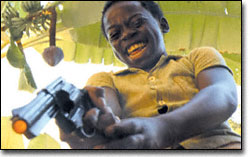
 “I smoke, I snort, I've killed and robbed. I'm a man” pleads 'Steak & Chips' an amusingly nicknamed boy in a unconvincing attempt to procure himself a gun; a symbol of membership to one of two rival gangs. 'Carrot' (the gangs power hungry leader) folds with very little persuasion and hands the child a weapon and with it his pass into the centre of a whirlwind of violence that will ultimately lead his nauseatingly premature death. Welcome to City of God, Fernando Meirelles's searing anecdotal allegory of violence and power, a film in which we are brutally reminded that the western culture we take for granted is really a massively under appreciated luxury.

The film portrays Cidade De Deus's (City of God) rapid decline, from a sunny coastal shanty town, home to children playing football in the streets, to a shadowy slum where gangs of rival adolescents mow each other down with handguns in a war they do not fully comprehend. Meirelles tells the tale through the unnervingly nonchalant narrations of a local boy named Rocket, who manages to narrowly escape the thuggery he grew up with through his aspiration of becoming a photographer (that and his comic ineptitude at crime).

By filming across the sprawling slum using hand held cameras Meirelles places his audience uncomfortably close to the visceral unfoldings; frequent implementations of low angle shots make Cidade De Deus a truly overwhelming environment and its inhabitants ferociously menacing as we are often forced to view events from a child's perspective. Its also safe to say that Meirelles has mastered the art of formalist editing as he frequently juxtaposes shots and symbols in order to create new meanings. For example the film opens to a comical chase scene in which we witness Lil Ze and his men (the movies main oppressive force) incompetently pursue a chicken through the winding Favela. This event is then cross-edited with Rocket (the films oppressed protagonist) disquieted over his current standing in the slum (he is an enemy to Lil Ze). This comparison of images makes Rocket the chicken in Lil Ze's chase; a powerful metaphor for his subservience to the domineering antagonist.

City of God shines even brighter upon closer inspection as Meirelles uses ingenuity and creative flare to ensure that his films mise en scene is saturated with visual metaphors and deep pragmatics. We witness the slum in the seventies as an open, vibrant dwelling with large expanses of golden sands; a slum from a child's perspective. This however is an angle quickly destroyed by a tsunami of drugs and violence as we witness our protagonists grow into hardened, volatile, yet painfully fragile gangsters, these golden pools are replaced with rich, dark shades that drown out the once charming shanty town's features, mirroring its inhabitants hardships.

'City of God' was an incredibly powerful, moving experience; one that managed to provoke emotions and empathy that very few films achieve. Meirelles's lush cinematography and frenetic editing ensure that the viewer is completely enthralled by an eye opening world of violence that could shock even the most hardened viewer.

Wednesday, 24 October 2012

City One Minutes


City One Minutes


We were shown a website called Cityoneminutes.com in a skills building seminar. The website contains one minute short films that give a taste of cities around the world over a period of twenty four hours. Myself and Luke were then set the task of creating our own one minute short film situated in cathedral square.

I feel it necessary to include this brief post on my blog as this was my first experience filming using sony Z1 cameras and editing using final cut pro. Before this task I had never filmed using manual settings or tape so this exercise provided a valuable learning experience. Because of our inexperience we found that a large proportion of our shots were overexposed and thus far too bright; a mistake that we have avoided whilst filming our experimental film thanks to the heightened level of knowledge we gleamed from shooting this short project. I also gained an improved level of insight into experimental film making, ignoring narrative and focusing on structure which has been extremely influential for my experimental film. 


We started editing by capturing our tape and importing it into final cut pro as raw footage. We then created three bins: assembly, rough cut and final cut. We found this three step method of editing very useful as it ensured that our work was organised sensibly. We then placed our footage into the rough cut bin in a logical order, we decided to group together the footage of trams and place it in the first half of the video, and place all our footage of the cathedral in the second half. After deciding the order of our shots we began placing them in the final cut bin and polishing them up; colour correcting and altering shot lengths to create a smooth edit. Finally when we were both happy with our film we exported the video directly to youtube from final cut.

This process helped hone our final cut skills as neither of us had any previous experience with the program. We implemented the three bins method in our experimental film after discovering it is a very effective, organised method of editing.


Saturday, 20 October 2012

Love Me Or Leave Me Alone Analysis

Love Me Or Leave Me Alone (Duane Hopkins, 2003)


Love me or leave me alone (a short film by Duane Hopkins) is a study of the unpredictability and tumult of a teenage relationship as well as the constricting limitations of first love. Set in a sleepy rural village, a young couple engage in a viscous argument that culminates in Steven (James Firkins) spitting in his distraught girlfriend’s face. Hopkins captures this scene of teenage acrimony using a mix of close ups and medium shots that uncomfortably frame the couple’s hormonal rage. The camera distance frequently switches between close and medium throughout this altercation almost mimicking the violent unpredictability of the characters’ relationship. It is not long after Steven expectorates on Jessica’s face that the couple go their separate ways; Steven opting to wallow in teenage angst in a wooden shelter by a football field and Jessica attempting to hitch a ride home. This parting of ways is captured with a wide angle shot to communicate the sudden distance the pair has created between one another. It almost seems ironic that Jessica holds her thumb up whilst attempting to flag down a ride after such a violent argument. This juxta position of images and ideas further highlights the changeability of teenage emotions whilst foregrounding the levity of the fight.

Now alone Steven has time to reflect on his actions and realises that he can’t escape his feelings for Jessica, thus contributing to the theme of the unpredictability of first love. I feel the grey, isolated setting mirrors the characters’ entrapment by their own feelings as neither of them have an efficient means of getting away from the village (Jessica attempting to hitch hike and Steven forced to use a push bike to try and catch up with her). This inadequacy reflects their inability to get away from their own ever-changing and completely overbearing emotions.


 A slave to his affections, Steven decides to chase after Jessica, the tone of the short switches at this point from the previous violence and aggression to a new found feeling desperation as neither character is really prepared to let go of one another. During the ensuing sequence Steven rides a push bike down a trail of country roads, eventually catching up with his distressed girlfriend. Throughout this scene cars fly past the pair in sudden bursts of abrupt diegetic sound, puncturing the uncomfortable silence. I feel that, during this scene, the cars represent established, mature relationships; they ease past, perfectly capable of reaching their destination, whereas Steven and Jessica struggle on foot down the isolated country lanes towards an unclear end.

After uneasy periods of silence the couple begin to talk once more in a run down abandoned structure: a perfect metaphor for the slow decomposition of a relationship. This moment is cross-edited with a sex scene between the pair, once more bringing to our attention the unfathomable emotions experienced in an inexperienced relationship. Not long after their display of intimacy the pair part ways, leaving with an uncertain exchange; they can’t stand to be around each other but at the same time irrevocably need one another. It is this emotional stalemate that Hopkins heavily dwells on in the films final act, focusing firmly on the point that Jessica and Steven are ultimately slaves to their emotions and because of this, have relatively little control over their actions. This bleak hypothesis accounts for the films ambiguous ending in which we see Steven walking off into the pitch black of night, occasionally splashed by pools of phosphorescent light from passing vehicles. Hopkins provides the audience with very little narrative resolution in a final attempt to emphasise the unpredictability of young love, as if to suggest that the couple’s struggle is ongoing and can never be resolved, merely repeated.

Whilst I feel Hopkins managed to obtain two impressive performances from his teenage protagonists the film is not entirely successful at delivering its message due to occasional moments of clunky camerawork and consistently dull compositions which detract from the films meaning. I feel far more subtlety is needed in order for the film to work, as its message is not intricately weaved into the films mise en scene and plot, much rather it is screamed at us by two hormonal teenagers. Whilst this approach does painfully hammer home ideas of teenage angst and unrest which we can all relate to, the film does not leave the viewer with any real sustenance to think about after the fifteen minute running time and as such I feel the message is somewhat lost; buried beneath pervasive profanity and moody performances.